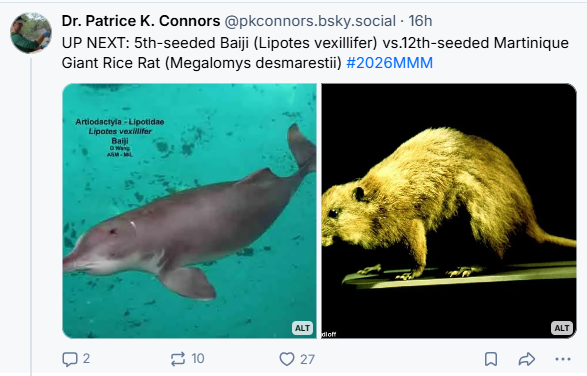
Baiji (aka the Yangtze River Dolphin) is a relatively small cetacean (167kg, 368lbs, just shy of 760 stoats) with a long snout that curves upward slightly, reminiscent of it's cousin the Amazon River Dolphin (Brownell & Herald 1972) #2026MMM #StoastsAsMeasurement
— Dr. Patrice K. Connors (@pkconnors.bsky.social) 2026-03-17T01:10:26.410Z
Baiji were found throughout the middle-lower Yangtze River and rivers and lakes that fed into it, but a 2006 survey was unable to find any individuals (Turvey et al 2007) #2026MMM doi.org/10.1098/rsbl…
— Dr. Patrice K. Connors (@pkconnors.bsky.social) 2026-03-17T01:10:59.202Z
#2026MMM #ExtinctionDivision #TeamBaiji Art by Valeria Pellicer @veppart.bsky.social
— V Pellicer- looking for work! (@veppart.bsky.social) 2026-03-17T01:11:28.258Z
We live in the post-genomic world but that technology is actually only been around for about 15 years so there is very little genome data for any species that went extinct before then. In 2007 Du et al make the first attempt at a genomic DNA library for the Baiji doi.org/10.2108/zsj…. #2026MMM
— Anne Stone (@acstone.bsky.social) 2026-03-17T01:11:31.367Z
Martinique Giant Rice Rat (aka Desmarest's pilorie) was a huge rodent (36cm head & body length, basically as long as a stoat, plus a long tail) that roamed it's namesake isle in the West Indies of the Caribbean (Miljutin 2010) #2026MMM #StoatsAsMeasurement
— Dr. Patrice K. Connors (@pkconnors.bsky.social) 2026-03-17T01:12:49.835Z
#2026MMM #ExtinctionDivision #TeamMartiniqueGiantRiceRat Art by Mary C. Freisner @maryfreisner.bsky.social
— V Pellicer- looking for work! (@veppart.bsky.social) 2026-03-17T01:13:25.127Z
Martinique Giant Rice Rats (Megalomys desmarestii) were once abundant on this small island of the Lesser Antilles, as known from the fossil record, pre-Columbian archaeological middens, and accounts from from early colonizers, incl this drawing possibly from life #2026MMM doi.org/10.1111/j.10…
— Anne Stone (@acstone.bsky.social) 2026-03-17T01:13:36.734Z
On this night 35 year ago, we find Baiji resting in the slow-moving waters of an eddy at the mouth of Poyang Lake, which empties into the long, winding and muddy Yangtze River #2026MMM
— Dr. Patrice K. Connors (@pkconnors.bsky.social) 2026-03-17T01:14:13.939Z
Close by are jagged cliffs leading to Shizhong Mountain, so named "rock bell" for producing fantastic sounds and echoes from the water splashing against the rocks #2026MMM http://www.visitourchina.com/jiujiang/att…
— Dr. Patrice K. Connors (@pkconnors.bsky.social) 2026-03-17T01:14:42.695Z
MEANWHILE, it is just before 8AM on May 8, 1902, on the Caribbean island of Martinique and Giant Rice Rat is scurrying through a coconut plantation along the Blanche River… driven by an instinct to flee from tiny seismic vibrations emanating from the ground… #2026MMM
— Dr. Patrice K. Connors (@pkconnors.bsky.social) 2026-03-17T01:14:58.029Z
BOOOOOOOOM!! WHOOOOOSH!!!!! #2026MMM
— Dr. Patrice K. Connors (@pkconnors.bsky.social) 2026-03-17T01:15:13.331Z
Mt. Pelée ERUPTS!!!! An ash-cloud surge and/or sideways dome explosion sends block-and-ash flow down the Blanche River basin DIRECTLY TOWARD MARTINIQUE GIANT RICE RAT! #PyroclasticCurrent #VolcanologistsStillDebatingSpecifics (Gueugneau et al. 2020) #2026MMM doi.org/10.3389/fear…
— Dr. Patrice K. Connors (@pkconnors.bsky.social) 2026-03-17T01:15:40.318Z
THE PYROCLASTIC PLUME IS RACING FASTER THAN THE RODENT… GAINING… GAINING… GAINING… #2026MMM
— Dr. Patrice K. Connors (@pkconnors.bsky.social) 2026-03-17T01:16:01.793Z
WHEN #MMMagic translocates Giant Rice Rat away from the final destruction of his species (& 29,000 people in the deadliest volcano eruption of the 20th Century) onto a steep, rocky shoreline near Jiujang, China by in the early '90s as a street dog is rushing by! #OhSnap #2026MMM
— Dr. Patrice K. Connors (@pkconnors.bsky.social) 2026-03-17T01:16:58.199Z
SPLASH!! The Giant Rice Rat leaps into the muddy waters below to avoid predation and splash-swims at the surface! (Flannery 2001) #2026MMM
— Dr. Patrice K. Connors (@pkconnors.bsky.social) 2026-03-17T01:17:15.193Z
CLICK CLICK CLICK!! Baiji feels water movement nearby and echolocates in the general direction of Giant Rice Rat, Baiji's head shaped specifically to receive echoes (Wei et al 2016) #2026MMM doi.org/10.1121/1.49…
— Dr. Patrice K. Connors (@pkconnors.bsky.social) 2026-03-17T01:17:44.103Z
Giant Rice Rat continues to splash about, getting more and more wet!! It's feet are better for digging and it's hair has little waterproofing ability, unlike other semiaquatic rodents (Miljutin 2010) #OhDear #2026MMM
— Dr. Patrice K. Connors (@pkconnors.bsky.social) 2026-03-17T01:18:20.054Z
Baiji slowly swims closer to Giant Rice Rat…. #2026MMM
— Dr. Patrice K. Connors (@pkconnors.bsky.social) 2026-03-17T01:18:42.044Z
… just as Giant Rice Rat finally finds secure footing and scurries into the rocks to find cover from dolphin and dog #2026MMM
— Dr. Patrice K. Connors (@pkconnors.bsky.social) 2026-03-17T01:19:13.668Z
BAIJI DEFEATS MARTINIQUE GIANT RICE RAT!! #2026MMM
— Dr. Patrice K. Connors (@pkconnors.bsky.social) 2026-03-17T01:19:24.658Z
#2026MMM #ExtinctionDivision #TeamBaiji Art by Valeria Pellicer @veppart.bsky.social
— V Pellicer- looking for work! (@veppart.bsky.social) 2026-03-17T01:19:35.479Z
However, Martinique Giant Rice Rats were extinct by around 1900 thanks to the introduction of mongoose predators and Mount Pelée erupting. Analysis of DNA + morphology show M. desmarestii sister to M. luciae from St. Lucia, which went extinct at the same time #2026MMM #RIP doi.org/10.1111/j.10…
— Anne Stone (@acstone.bsky.social) 2026-03-17T01:19:48.174Z
Next Up: #2-seed Wild Dromedary Camel (Camelus dromedarius) vs. #15-seed NZ Greater Short-Tailed Bat (Mystacina robusta) #2026MMM
— Alyson Brokaw, PhD (@alybatgirl.bsky.social) 2026-03-17T01:21:53.622Z
Every day is hump day! Dromedary camels can be distinguished from the related Bactrian camels by the presence of only 1 hump. They are also slightly taller, with male camel shoulders reaching heights of 6.5 ft (or ~ 8 stoats) #StoatsAsMeasurement #2026MMM
— Alyson Brokaw, PhD (@alybatgirl.bsky.social) 2026-03-17T01:22:30.316Z
Though there are feral dromedary camels in some places, wild dromedary camels have been functionally extinct for between 2000-3000 years following domestication in the Arabian peninsula. #2026MMM
— Alyson Brokaw, PhD (@alybatgirl.bsky.social) 2026-03-17T01:23:01.354Z
#2026MMM #ExtinctionDivision #TeamWildDromedaryCamel Art by Mary C. Freisner @maryfreisner.bsky.social
— V Pellicer- looking for work! (@veppart.bsky.social) 2026-03-17T01:23:30.784Z
The wild ancestor of the dromedary camel vanished a few thousand years ago, but its domesticated descendants survive in captivity. Genetic studies point to mitochondrial genes ATP6 and CYTB as candidates for metabolic adaptations to harsh desert environments. #2026MMM doi.org/10.3390/ani1…
— Anne Stone (@acstone.bsky.social) 2026-03-17T01:24:23.372Z
One of only three land mammals native to New Zealand (all bats!), the NZ Greater Short-tailed Bat was last seen on Big South Cape Island in 1967, shortly after ship rats invaded the island (O'Donnell 2021) #2026MMM
— Alyson Brokaw, PhD (@alybatgirl.bsky.social) 2026-03-17T01:25:29.104Z
The incursion of rats also led to attempts at several seabird translocations. At the time, the bat was thought to be the same species as the still existing lesser short-tailed bat, so translocations were never attempted (Bell et al 2016). #2026MMM
— Alyson Brokaw, PhD (@alybatgirl.bsky.social) 2026-03-17T01:25:49.621Z
#2026MMM #ExtinctionDivision #TeamNewZealandGreaterShortTailedBat #TeamPekapeka Art by Valeria Pellicer @veppart.bsky.social
— V Pellicer- looking for work! (@veppart.bsky.social) 2026-03-17T01:26:06.187Z
Mystacina only had two species before one went extinct in 1965 but their placement in the bat tree of life is a difficult problem for biologists, even with the use of DNA doi.org/10.1006/mpev… #2026MMM
— Anne Stone (@acstone.bsky.social) 2026-03-17T01:26:10.131Z
We start tonight on Big South Cape Island, NZ in 1965. Dark has fallen and our Bat has just landed on the soft ground. Using a "scuttling walk" unique to New Zealand bats (Hand et al 2009), it searches for grubs among fallen leaves #2026MMM
— Alyson Brokaw, PhD (@alybatgirl.bsky.social) 2026-03-17T01:27:02.485Z
Just as Bat scuttles along the edge of a nearby bush, a RAT lunges out, teeth bared! Bat spreads its wings in an attempt to take flight when an MMM portal opens up… #2026MMM
— Alyson Brokaw, PhD (@alybatgirl.bsky.social) 2026-03-17T01:27:22.358Z
…Dropping the tangled Bat/rat in the Nefud desert, 12,000 years ago! A bright sun reflects off the animal carvings on the desert cliffs and the surface of the nearby watering hole. Grunts, hums and snuffles of camels fill the air #2026MMM.
— Alyson Brokaw, PhD (@alybatgirl.bsky.social) 2026-03-17T01:28:54.072Z
Our male Camel combatant stands, hindlegs spread wide. It is rutting season and he has just spotted a possible RIVAL male a few meters away. Head lowering, lifting and bending backwards, Camel grinds his teeth as saliva drips onto the sand (Kohler-Rollefson 1991) #2026MMM
— Alyson Brokaw, PhD (@alybatgirl.bsky.social) 2026-03-17T01:29:32.445Z
Not to be dissuaded from its meal, the rat presses the Bat into the sand with its forelegs. It goes to take the killing bite when…BLECH! #2026MMM
— Alyson Brokaw, PhD (@alybatgirl.bsky.social) 2026-03-17T01:29:55.631Z
A harsh stream of urine sprays down onto the Bat and rat as Camel wets his tail and flaps it onto his back in display (Kohler-Rollefson 1991). Camel takes a step towards the rival camel. #2026MMM
— Alyson Brokaw, PhD (@alybatgirl.bsky.social) 2026-03-17T01:31:11.525Z
Now soaked, Bat pulls free from the rat's paws. With an awkward push into the ground, Bat launches itself into the air and towards the nearby cliffs, vacating the field of battle as tiny drips of pee sprinkle down on the sand. #2026MMM
— Alyson Brokaw, PhD (@alybatgirl.bsky.social) 2026-03-17T01:32:09.337Z
Sizing up our Camel combatant, the rival male retreats, leaving #2026MMM Combatant Camel DOUBLY victorious at the edge of the oasis. #2026MMM
— Alyson Brokaw, PhD (@alybatgirl.bsky.social) 2026-03-17T01:32:45.554Z
Wild Dromedary Camel OUTLASTS NZ Greater Short-Tailed Bat!! #2026MMM
— Alyson Brokaw, PhD (@alybatgirl.bsky.social) 2026-03-17T01:33:11.187Z
#2026MMM #ExtinctionDivision #TeamWildDromedaryCamel Art by Mary C. Freisner @maryfreisner.bsky.social
— V Pellicer- looking for work! (@veppart.bsky.social) 2026-03-17T01:33:18.447Z
Using a combination of available DNA markers, Teeling et al grouped the NZ Greater Short-tailed bats with the bulldog bats, a family of South American bats; and proposed their ancestors originated in Australia and dispersed to NZ and SA respectively doi.org/10.1016/S105… #2026MMM #RIP
— Anne Stone (@acstone.bsky.social) 2026-03-17T01:33:25.805Z
UP NEXT: 4th-seeded Caribbean Monk Seal (Neomonachus tropicalis) vs. 13th-seeded Yallara (Macrotis leucura), a special collaboration between @mammalssuck.bsky.social & yours truly #2026MMM
— Dr. Patrice K. Connors (@pkconnors.bsky.social) 2026-03-17T01:35:49.003Z
Caribbean Monk Seal, foca monje del Caribe in Spanish, was first described by Europeans in 1494 as a triton or merman (likely 6-8ft long & 400-600lbs), the "color between brown & russet… with a downy of long, sparse hairs… noses riveted & wide" (Viloria et al, 2024) #2026MMM
— Dr. Patrice K. Connors (@pkconnors.bsky.social) 2026-03-17T01:36:31.489Z
These seals were likely found throughout the Caribbean, with highest numbers seen between Cuba & the Yucatan. The last confirmed sighting of this pinniped was in 1952. Unlike Thylacine & Dodo, the only seal native to the Gulf of Mexico never became an extinction icon #2026MMM
— Dr. Patrice K. Connors (@pkconnors.bsky.social) 2026-03-17T01:36:47.837Z
#2026MMM #ExtinctionDivision #TeamCaribbeanMonkSeal Art by Olivia Pellicer @opellisms.bsky.social
— V Pellicer- looking for work! (@veppart.bsky.social) 2026-03-17T01:37:05.357Z
As Caribbean monk seals went extinct before DNA technology it was unclear how they were related to other seals. Through ancient DNA, Scheel et al found they are more related to Pacific rather than Mediterranean monk seals, & the three were their own branch of seals doi.org/10.3897/zook… #2026MMM
— Anne Stone (@acstone.bsky.social) 2026-03-17T01:37:07.486Z
Yallara (or lesser bilby or lesser rabbit-eared bandicoot) was a small (450g) hopping marsupial with an elongated snout full of sharp teeth, tall rabbit-like ears, long tail, & robust toes & claws to dig for food in the sandy soils of Australia's arid deserts #2026MMM
— Dr. Patrice K. Connors (@pkconnors.bsky.social) 2026-03-17T01:37:51.618Z
Yallara became scarce in the 1930s & were declared extinct in the 1950s. Years later a skull was found in an owl pellet – a sad reminder of what had been #2026MMM
— Dr. Patrice K. Connors (@pkconnors.bsky.social) 2026-03-17T01:38:44.125Z
Hogg et al. (2023) sequenced DNA from Yallara museum specimens collected between 1895 & 1931, before the species vanished. Their analyses reveal population declines beginning 300K-4M years ago, coinciding with global cooling before the last glacial period. #2026MMMwww.nature.com/articles/s41…
— Anne Stone (@acstone.bsky.social) 2026-03-17T01:39:16.823Z
It's 1707 & Caribbean Monk Seal has hauled out onto the beaches of largest atoll in the southern Gulf of Mexico – Scorpion Reef (Arrecife Alacranes, now a national park!). Many seals are here for the annual molt, mostly uninterested in each other #BeachDay #2026MMM
— Dr. Patrice K. Connors (@pkconnors.bsky.social) 2026-03-17T01:40:11.295Z
Monk seals, like Elephant seals, shed their fur & outer layer of skin to keep their fur healthy in a process called "catastrophic molt" over a number of days. The seals appearance changes drastically during this time, often looking patchy & ragged #2026MMM
— Dr. Patrice K. Connors (@pkconnors.bsky.social) 2026-03-17T01:40:43.137Z
MEANWHILE, Yallara hops through open plains bordering the Sturt Stony Desert in South Australia (Vernes et al 2021). Yallara forages for a tasty meal while safely avoiding introduced predators, when #MMMagic suddenly transports it to Caribbean Monk Seal's molting beach! #2026MMM
— Dr. Patrice K. Connors (@pkconnors.bsky.social) 2026-03-17T01:41:12.177Z
Yallara doesn't mind the sandy beach but the sunlight is too much for nocturnal marsupial, who prefers to spend bright, hot days curled in a burrow… but OOO, the sparkling water is astonishing! Having never seen the ocean, Yallara hops towards the water… #2026MMM
— Dr. Patrice K. Connors (@pkconnors.bsky.social) 2026-03-17T01:41:28.790Z
WHEN HUMANS ARRIVE!! Caribbean Monk Seals were hunted systematically for lamp oil (similar to whales, ".. for Lamps on these Islands") and coating ships ("… the fat of which pay [i.e. coat] the bottom of their ships"), and their meat eaten (Jørgensen, 2021) #2026MMM
— Dr. Patrice K. Connors (@pkconnors.bsky.social) 2026-03-17T01:41:58.476Z
The seals lay "in a lethargic sleep" as hunters block the cove then start to flush the seals up beach, sending some seals fleeing in a undulating pinniped stampede… #2026MMM
— Dr. Patrice K. Connors (@pkconnors.bsky.social) 2026-03-17T01:42:22.406Z
Yallara panic-hops in the undulating pinniped stampede, massive seal bodies crushing into the sand (FA-LUUUMP, FA-LUUUUMP)! In the chaos, Yallara hops near combatant Caribbean Monk Seal, who is not moving… #2026MMM
— Dr. Patrice K. Connors (@pkconnors.bsky.social) 2026-03-17T01:42:49.544Z
BECAUSE some of the seals are "sluggishly careless" due to little experience being so intensively hunted, becoming easy prey to the humans clubbing & spearing the clueless seals, vulnerable on the beach!! (Jørgensen, 2021) #2026MMM
— Dr. Patrice K. Connors (@pkconnors.bsky.social) 2026-03-17T01:43:12.380Z
Surviving the massacre… Yallara hops to the next beach over, only to discover it "filled with SKELETONS AND HIDES" of previously "oyl" processed seals, a scene common across the Caribbean for hundreds of thousands of seals (Jørgensen, 2021; McClenachan & Cooper 2008) #2026MMM
— Dr. Patrice K. Connors (@pkconnors.bsky.social) 2026-03-17T01:43:42.862Z
YALLARA OUTLASTS CARIBBEAN MONK SEAL!!! #2026MMM #QuestsForOil #NatureBurns #Upset #InMoreWaysThanOne
— Dr. Patrice K. Connors (@pkconnors.bsky.social) 2026-03-17T01:44:12.646Z
#2026MMM #ExtinctionDivision #TeamYallara Art by Mary C. Freisner @maryfreisner.bsky.social
— V Pellicer- looking for work! (@veppart.bsky.social) 2026-03-17T01:44:32.310Z
Caribbean monk seal ancient DNA tells us they split from the Pacific monk seal right before the formation of the Isthmus of Panama. At some stage, seals were unable to mate across the Panama Arc possibly due to dangerous currents or lack of suitable habitats doi.org/10.1007/s002… #2026MMM #RIP
— Anne Stone (@acstone.bsky.social) 2026-03-17T01:44:41.451Z
Last up of the Night: #7-seed Falkland Island Wolf (Dusicyon australis) vs. #10-seed Sea Mink (Neogale macrodon)! #2026MMM
— Katie Hinde (@mammalssuck.bsky.social) 2026-03-17T01:48:42.732Z
Yes the Cunning Canid vs. the Mighty Mustelid in a battle that could only be described by @natickbobcat.bsky.social as "Can't they BOTH LOSE"?!? #2026MMM
— Katie Hinde (@mammalssuck.bsky.social) 2026-03-17T01:49:08.914Z
The sturdy, fox-sized tawny, tan, black & buffy Falkland Island Wolf WAS NOT A WOLF! OR A FOX! Instead on the weirdie branch of South American canids that includes Chrysocyon brachyurus (Maned Wolf #NotAWolf) & Speothos venaticus (Bush Dog #NotADog) (Oshman 2012; Zrzavý et al. 2018).
— Katie Hinde (@mammalssuck.bsky.social) 2026-03-17T01:50:09.236Z
Today the Falkland Islands lie 460km out in the South Atlantic, but in the Last Glacial Maximum when sea levels were lower, a shallow marine strait ~20km periodically froze over (or #IceRafts) likely allowed the canid to disperse, then become isloated from the mainland (Austin et al 2013) #2026MMM
— Katie Hinde (@mammalssuck.bsky.social) 2026-03-17T01:51:01.883Z
#2026MMM #ExtinctionDivision #TeamFalklandIslandsWolf Art by Olivia Pellicer @opellisms.bsky.social
— V Pellicer- looking for work! (@veppart.bsky.social) 2026-03-17T01:51:19.254Z
How did the Wolf reach the Falkland Islands? #2026MMMDNA evidence shows its lineage diverged from mainland relatives 330K years ago, long before humans reached the region. The wolves may have reached the islands by rafting on debris or crossing glacial ice from Patagonia. doi.org/10.1016/j.cu…
— Anne Stone (@acstone.bsky.social) 2026-03-17T01:51:30.314Z
The sea mink was a large mustelid with ruddy brown fur but "was hunted to extinction in the latter part of the 19th century, even before it was taxonomically described or scientifically studied" (Sealfon 2007) #2026MMM
— Katie Hinde (@mammalssuck.bsky.social) 2026-03-17T01:52:30.768Z
Sea Mink was to American mink as Polar Bears are to Grizzly Bears… meaning from an already incredible ancestor diverged a bigger, beastier version adapted to hunt marine resources. #EarlyLandToSeaEvolutionaryTransition (Sealfon 2007) #2026MMM
— Katie Hinde (@mammalssuck.bsky.social) 2026-03-17T01:52:59.138Z
#2026MMM #ExtinctionDivision #TeamSeaMink Art by Charon Henning @oddangel.bsky.social
— V Pellicer- looking for work! (@veppart.bsky.social) 2026-03-17T01:53:34.691Z
What we call “weasels” is a taxonomic group that includes stoats, polecats, ermines, mink, ferrets and SOME weasels, in the genus Mustela. The rest form their own taxonomic group called the “American Weasels” in the genus Neogale (including the extinct sea mink) doi.org/10.1186/1741… #2026MMM
— Anne Stone (@acstone.bsky.social) 2026-03-17T01:53:43.112Z
Tonight we go 3000 years INTO THE PAST to what are today called the Falkland Islands,A Falkland Island Wolf climbs from his sandy burrow, a drier option than the soggy moorland & boggy peatlands elsewhere on the island. #2026MMM
— Katie Hinde (@mammalssuck.bsky.social) 2026-03-17T01:55:05.508Z
Falkland Island Wolf is the only only endemic terrestrial mammal to inhabit to inhabit these lands and he sets out to hunt. #2026MMM
— Katie Hinde (@mammalssuck.bsky.social) 2026-03-17T01:55:22.349Z
MEANWHILE: 2000 years ago a Sea Mink is diving in the surf for invertebrates in what today is called North Haven Island in Penobscot Bay in the Gulf of Maine, where the "richest known assortment of sea mink bones" have been found. (Sealfon 2007) #2026MMM
— Katie Hinde (@mammalssuck.bsky.social) 2026-03-17T01:55:35.774Z
Sea Mink surfaces, a hardshell invertebrate in his teeth, scurrying onto a rock, Sea Mink crushes his catch with his wide-robust upper carnassials against the broader lower carnassials (Sealfron 2007). #2026MMM
— Katie Hinde (@mammalssuck.bsky.social) 2026-03-17T01:56:11.915Z
Sea Mink's teeth aren't as adept at this task as an otter, but better adapted for this activity than American mink (Sealfron 2007). #2026MMM
— Katie Hinde (@mammalssuck.bsky.social) 2026-03-17T01:56:58.053Z
Diving back into the water, Sea Mink surfaces to find himself #MMMagically translocated to the kelp-choked surf on the shore of the Falklands…. astonished by scene before him… #2026MMM
— Katie Hinde (@mammalssuck.bsky.social) 2026-03-17T01:57:17.949Z
MARCH is an active time on the Falklands as the summer wanes. Sea lion pups are transitioning from mother's milk to pup social groups & learning to fish… while rockhopper, gentoo, magellanic, and king penguin chicks are fledging! #2026MMM http://www.falklandislands.com/plan-your-tr…
— Katie Hinde (@mammalssuck.bsky.social) 2026-03-17T01:57:43.865Z
Such Southern Hemisphere birds would have been unknown to the Sea Minkbut he would have no doubt thought they were the Northern Hemisphere's flightless birdthe Great Auk! #NotAPenguinanother Anthropocene extinction (Iglésias & Fournier-Sowinski 2024). #2026MMM #BonusArt @veppart.bsky.social
— Katie Hinde (@mammalssuck.bsky.social) 2026-03-17T01:58:42.052Z
Spotting a lone rockhopper fledgling on the edge of the colony, FALKLAND ISLAND WOLF begins slinking from the sandhills… #2026MMM
— Katie Hinde (@mammalssuck.bsky.social) 2026-03-17T01:59:20.065Z
Sea Mink's mighty mustelid jaws snap fatally snap into the flapping fledgling… just as Falkland Island Wolf pulls up short, staring with "curiosity and tameness" at the newcomer! (Renshaw 1905) #2026MMM
— Katie Hinde (@mammalssuck.bsky.social) 2026-03-17T02:01:04.036Z
Sea Mink has ownership of the prey and is more motivated to fight to keep it! Dropping the dead fledgling, Sea Mink growls with bared, bloody teeth! #2026MMM
— Katie Hinde (@mammalssuck.bsky.social) 2026-03-17T02:01:37.417Z
Falkland Island Wolf "utters a feeble, yapping bark" and steps forward (Renshaw 1905) #2026MMM
— Katie Hinde (@mammalssuck.bsky.social) 2026-03-17T02:02:07.086Z
Sea Mink jumps forward, snapping canines flashing and the Falkland Island Wolf falls back, intimidated by the pugnacious mustelid from an ecosystem of REAL WOLVES #2026MMM
— Katie Hinde (@mammalssuck.bsky.social) 2026-03-17T02:03:05.703Z
With plenty of potential prey, less contentiously captured… Falkland Island Wolf departs to hunt elsewhere QUITTING THE FIELD OF BATTLE! #2026MMM
— Katie Hinde (@mammalssuck.bsky.social) 2026-03-17T02:03:43.422Z
Sea Mink INTIMIDATES Faulkland Island Wolf!!! #UpsetCity #MightyMustelid #2026MMM
— Katie Hinde (@mammalssuck.bsky.social) 2026-03-17T02:04:02.836Z
#2026MMM #ExtinctionDivision #TeamSeaMink Art by Charon Henning @oddangel.bsky.social
— V Pellicer- looking for work! (@veppart.bsky.social) 2026-03-17T02:04:21.034Z
Closest relative of the Falkland Islands Wolf (Dusicyon australis)? ➡️ The also-extinct pampas wolf (D. avus). Lineages split 16K years ago. Ancient DNA from both species helped reconstruct their evolutionary history… and remind us they’re gone forever. #RIP #2026MMM http://www.nature.com/articles/nco…
— Anne Stone (@acstone.bsky.social) 2026-03-17T02:04:27.534Z
WOW WHAT A NIGHT! BaijiWild Dromedary CamelStellar's Sea CowThylacineAurochsSaudi GazelleYallaraSea Mink ADVANCE! Join us WEDNESDAY for the THAT'S SO METAL DIVISION! #2026MMM
— Katie Hinde (@mammalssuck.bsky.social) 2026-03-17T02:05:20.434Z
And let us thank those Natural Historians of the past and the Geneticists of today… and the Historical Ecologists… and the Teeth Researchers… and the Museum Curators for the science that let us tell these stories of the lost species #ExtinctionIsForever #2026MMM
— Katie Hinde (@mammalssuck.bsky.social) 2026-03-17T02:06:28.234Z
💀 IS FOREVER EMOJI BATTLE#2026MMM Round 1🐮🆚🐭:🐭🍽️👶🏼/🐮🌊🐭/🏆🐮🐐🆚🦦:🏜️💨🦦/🦦➡️🪨/🏆🐐🐬🆚🐀:🌋🐕🐀/🐀🏊♂️🪨/🏆🐬🦭🆚🦘:🏌️♂️🦭😴/🦘🏖️😬/🏆🦘🐯🆚🐹:🪄🐹🙂/🐯🍽️🐹/🏆🐯🐂🆚🐁:🐁🍽️🌾/🦶🐁😰/🏆🐂🐺🆚🧥:🐺🧥🐧/🧥😡🐺/🏆🧥🐪🆚🦇:〽️🦇🐀/🦇🆙👋/🏆🐪
— Jess Popescu (@jesspopescu.bsky.social) 2026-03-17T02:08:12.156Z
#2026MMM EXTINCTION IS FOREVER ROUND 1 WINNERS: Steller's Sea Cow, Saudi Gazelle, Baiji, Yallara, Thylacine, Aurochs, Sea Mink, and Wild Dromedary Camel!Please join us Wednesday 3/18 at 8PM EST for Round 1 of That's So Metal!
— March Mammal Madness (@mmmletsgo.bsky.social) 2026-03-17T02:08:39.390Z
 Christopher N Anderson
Leave a comment